Pavithra Prabhakar
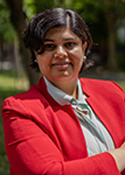
Professor, Cleve Moler and MathWorks Endowed Chair in Mathematical and Engineering Software
Department of Computer Science
Education
PhD, Computer Science, University of Illinois at Urbana-Champaign, 2011
MS, Applied Mathematics, University of Illinois at Urbana-Champaign, 2010
MS, Computer Science, Indian Institute of Science, Bangalore, 2006
BS, Computer Science, National Institute of Technology, Warangal, 2004
Biography
Pavithra Prabhakar is a Professor in the Department of Computer Science and the Cleve Moler and MathWorks Endowed Chair in Mathematical and Engineering Software at The University of New Mexico. Prior to joining UNM, she was a Professor of Computer Science and the Peggy and Gary Edwards Chair in Engineering at Kansas State University. She earned her Ph.D. in Computer Science and an M.S. in Applied Mathematics from the University of Illinois Urbana–Champaign, followed by a CMI Postdoctoral Fellowship at the California Institute of Technology.
Prabhakar’s research focuses on formal methods for AI-enabled autonomous, cyber-physical, and robotic systems, with applications in aerospace, automotive, and agricultural automation. She has authored over 100 peer-reviewed publications and has received numerous honors, including a Marie Curie Career Integration Grant from the EU, NSF CAREER Award, ONR Young Investigator Award, NITW Distinguished Young Alumnus Award, Amazon Research Award, CRA Future Leader recognition, and a 2025 Early Career Academic Achievement Alumni Award from UIUC.
More recently, she served as a Program Director at the National Science Foundation (NSF) in the CISE Directorate, where she led and oversaw a portfolio of over 200 research projects with a total budget exceeding $100 million, spanning Formal Methods, Cyber-Physical Systems, Robotics, and Artificial Intelligence. Specifically, she was a founding program director for the Safe Learning-Enabled Systems (SLES) program and was a lead for the Formal Methods in the Field (FMitF) program.
Teaching Interests
- Theory of computation
- Algorithms
- Formal Verification
Research Interests
- Trustworthy AI and Autonomy
- Formal Methods
- Cyber-Physical Systems
- Robotics